

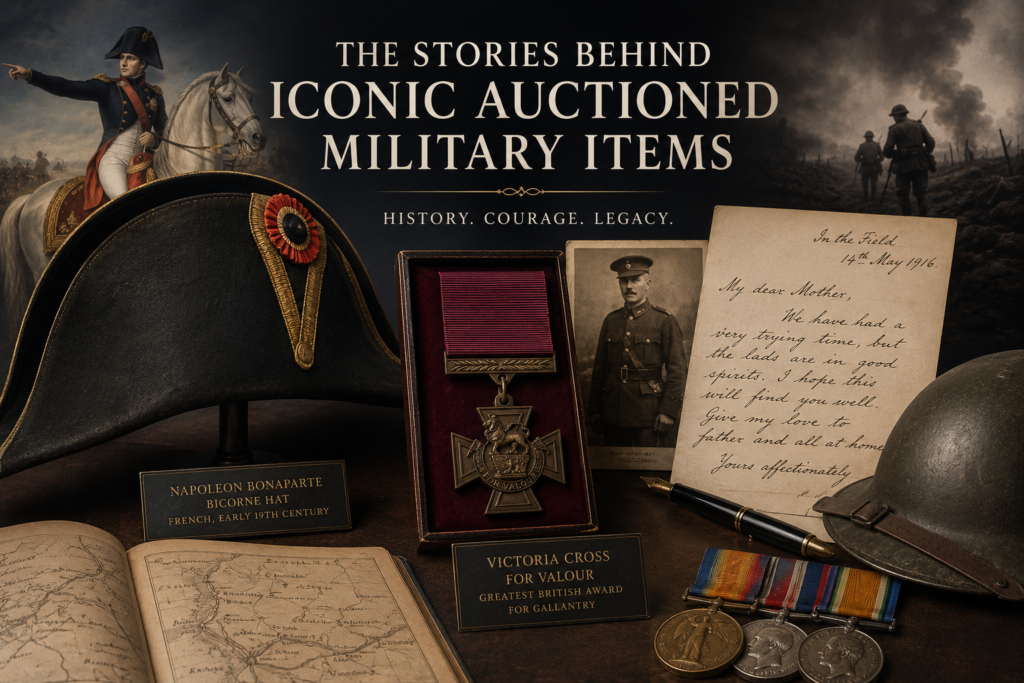
The Stories Behind Iconic Auctioned Military Items
In the world of militaria collecting, every item carries more than just metal, fabric, or patina — it holds a fragment of history, courage, tragedy, or triumph. When rare military artifacts reach the auction block, their value often stems less from rarity alone and more from the human stories they represent. At our militaria auction platform, we see collectors drawn to pieces with documented provenance because these objects transform from relics into tangible connections to the past.
One of the most legendary sales remains Napoleon Bonaparte’s sword, which fetched a record $6.5 million in 2007. This curved steel blade with an ebony and gold handle accompanied the French emperor to the Battle of Marengo in 1800, a decisive victory that solidified his power. Far more than a weapon, it symbolized military genius and the sweeping ambitions of the Napoleonic era. The sword’s journey from battlefield to auction house underscores how personal items tied to towering historical figures command extraordinary prices.
Another standout from the Napoleonic Wars is the 1812 Eagle Standard of the 4th Regiment of Napoleon’s Imperial Guard, sold for $2.4 million in 2018. These eagle-topped standards served as rallying points for troops in the heat of battle. Losing one brought shame; capturing one brought glory. This particular standard witnessed the brutal campaigns of the Grande Armée, surviving the chaos of war only to become a prized collector’s trophy centuries later. Its sale highlighted the enduring power of regimental symbols.
Moving to American military history, the Colt Walker 1847 revolver carried by Captain Samuel H. Walker during the Mexican-American War realized $1.84 million in 2008. Walker, a Texas Ranger and close collaborator with Samuel Colt, helped refine the powerful revolver that became iconic on the frontier. The pistol’s direct link to early U.S. expansion and frontier warfare adds layers of meaning that elevate it far beyond a functional firearm.
Civil War artifacts frequently tell stories of valor and sacrifice. A hand-painted 1864 battle flag carried by Pennsylvania’s 127th Regiment of United States Colored Troops sold for nearly $197,000 at Morphy Auctions. Created by African-American artist David Bustill Bowser, it is the only surviving example of the flags he made for Black Union regiments. This flag witnessed fierce combat and stands today as a powerful testament to the contributions and bravery of soldiers who fought for freedom while facing discrimination at home.
In the realm of World War II, provenance continues to drive record results. Items with clear chains of ownership — such as named uniforms, helmets, or medals awarded for extraordinary heroism — consistently outperform anonymous pieces. A Victoria Cross medal awarded to Australian Private Edward Kenna for his actions in New Guinea in 1945 sold for significant sums, its story of selfless courage under fire resonating deeply with collectors. Similarly, high-ranking officers’ groupings, complete with documented service records, often spark intense bidding wars.
What makes these items so compelling at auction? Provenance transforms an object into a narrative. A helmet worn at Waterloo, a sword carried at Marengo, or a flag raised by freedmen soldiers in the Civil War allows collectors to hold history in their hands. Serious buyers seek not just the artifact but the verifiable story: service records, period photographs, family letters, or auction house research that confirms authenticity.
At our militaria auction site, we specialize in bringing such pieces to market with rigorous vetting and detailed historical context. Whether you are consigning a family heirloom with a documented battlefield past or seeking to acquire a piece that tells a larger story, the emotional and historical weight often matters as much as condition or rarity.
These iconic sales remind us why militaria collecting remains a passionate pursuit. Each auctioned item is a portal to the men and women who shaped our world through conflict and sacrifice. The next great story may be waiting in your attic, or it could be the next lot crossing the block.